
Director Teahna Stephens
Teahna Stephens serves as the Director of Mosquito Control and brings a diverse background in entomology, public health, environmental science, and community education. She earned both her Bachelor of Science in Exercise and Movement Science–Health Studies and her Master of Science in Health Promotion and Wellness Management with an emphasis in Public Health from Missouri State University. Throughout her career, she has remained committed to protecting public health through science-based mosquito surveillance, vector control, and public outreach initiatives.
Teahna began her mosquito control career as an Entomologist, where she specialized in mosquito identification, surveillance, resistance testing, arbovirus monitoring, and laboratory management. Her experience includes coordinating larval and adult mosquito population surveys, evaluating trapping techniques, conducting insecticide efficacy testing, and managing sentinel chicken surveillance programs for arbovirus detection. She has also worked as an Environmental Scientist supporting stormwater and environmental compliance programs, including GIS/GPS mapping and public education initiatives.
In addition to her technical expertise, Teahna is passionate about leadership development, staff training, and public education. She has taught workshops and training courses focused on mosquito identification, trapping methods, vector surveillance, and integrated pest management. Her background in health education and wellness also provides a unique perspective on community engagement and preventative public health practices.
Teahna holds multiple professional certifications, including Certified Public Manager (CPM), Certified Health Education Specialist (CHES), Public Health Pest Control License, and Aquatic and Right-of-Way Pesticide Licenses. She is dedicated to advancing innovative, environmentally responsible mosquito control strategies while fostering strong relationships within the community and the public health field.


Staff

Board Meeting Information & District Transparency Information
Agendas
Board Meeting Agendas
Board Minutes
Budget
District's Performance Standards
Beach Mosquito Control District Goals, Objectives, Performance Standards and Measures:
Goal 1: Disease Prevention
- Objective: Reduce mosquito populations.
Performance Standard: A significant decrease in the prevalence of mosquito-borne diseases within the target area.
Measures: Incidence rates of diseases like malaria, dengue, West Nile virus, Zika, etc.
- Objective: Target disease-carrying mosquitoes.
Performance Standard: A reduction in the population of disease-carrying mosquito species.
Measures: Mosquito surveillance data, species-specific trap counts, and genetic analysis.
- Objective: Monitor disease outbreaks.
Performance Standard: Timely detection and response to disease outbreaks.
Measures: Surveillance systems, public health reporting, and outbreak investigation protocols.
Goal 2: Nuisance Reduction
- Objective: Create comfortable outdoor spaces.
Performance Standard: A reduction in public complaints related to mosquito nuisance.
Measures: Public surveys, social media monitoring, and complaint tracking systems.
- Objective: Support economic activities.
Performance Standard: Minimal negative impact on tourism, outdoor events, and other economic activities.
Measures: Economic indicators, business surveys, and event attendance data.
Goal 3: Environmental Stewardship
- Objective: Minimize pesticide use.
Performance Standard: A reduction in pesticide applications and overall pesticide use.
Measures: Pesticide usage records, environmental monitoring, and compliance with regulations.
-
Objective: Promote sustainable practices.
Performance Standard: Implementation of environmentally friendly control methods.
Measures: Adoption of alternative control techniques (e.g., biological control, habitat modification), compliance with environmental regulations, and ecological assessments.
-
Objective: Conserve biodiversity.
Performance Standard: Minimal negative impact on non-target organisms.
Measures: Monitoring of beneficial insects, wildlife populations, and aquatic ecosystems.
Goal 4: Community Engagement
- Objective: Build trust and collaboration.
Performance Standard: Increased public satisfaction with the agency’s efforts.
Measures: Public surveys, social media engagement, and community meeting attendance.
-
Objective: Increase public participation.
Performance Standard: Active involvement of the community in mosquito control activities.
Measures: Community-based monitoring programs, and public outreach initiatives.
-
Objective: Address community concerns.
Performance Standard: Timely and effective response to public inquiries and complaints.
Measures: Complaint resolution rates, response times, and public satisfaction surveys.
Goal 5: Research and Development
- Objective: Develop innovative control methods.
Performance Standard: Successful development and implementation of new control technologies.
Measures: Publications and adoption of new methods.
-
Objective: Improve existing methods.
Performance Standard: Increased effectiveness and efficiency of current control practices.
Measures: Field trials, comparative studies, and cost-benefit analyses.
-
Objective: Understand mosquito biology.
Performance Standard: Advancement of scientific knowledge related to mosquito biology and ecology.
Measures: Publications, presentations, and collaborations with academic institutions.
BMCD Annual Reports
Downloads
Meeting Dates
- October 6th, 2025
- November 10th, 2025
- December 8th, 2025
- January 12th, 2026
- February 9th, 2026
- March 16th, 2026
- April 13th, 2026
- May 11th, 2026
- June 8th, 2026
- July 13th, 2026
- August 10th, 2026
- September 14th, 2026
Transparency
Legal
Special Districts are required to post the following information on their official website. This is the official website for Beach Mosquito Control District.
Full Legal Name
Beach Mosquito Control District
Mailing Address
Telephone
Website Address
Email Addresses
Director: james@pcbeachmosquito.com
Commissioner Seat 1: larshayc@hotmail.com
Commissioner Seat 2: caldwell8678@yahoo.com
Commissioner Seat 3: docmx8@gmail.com
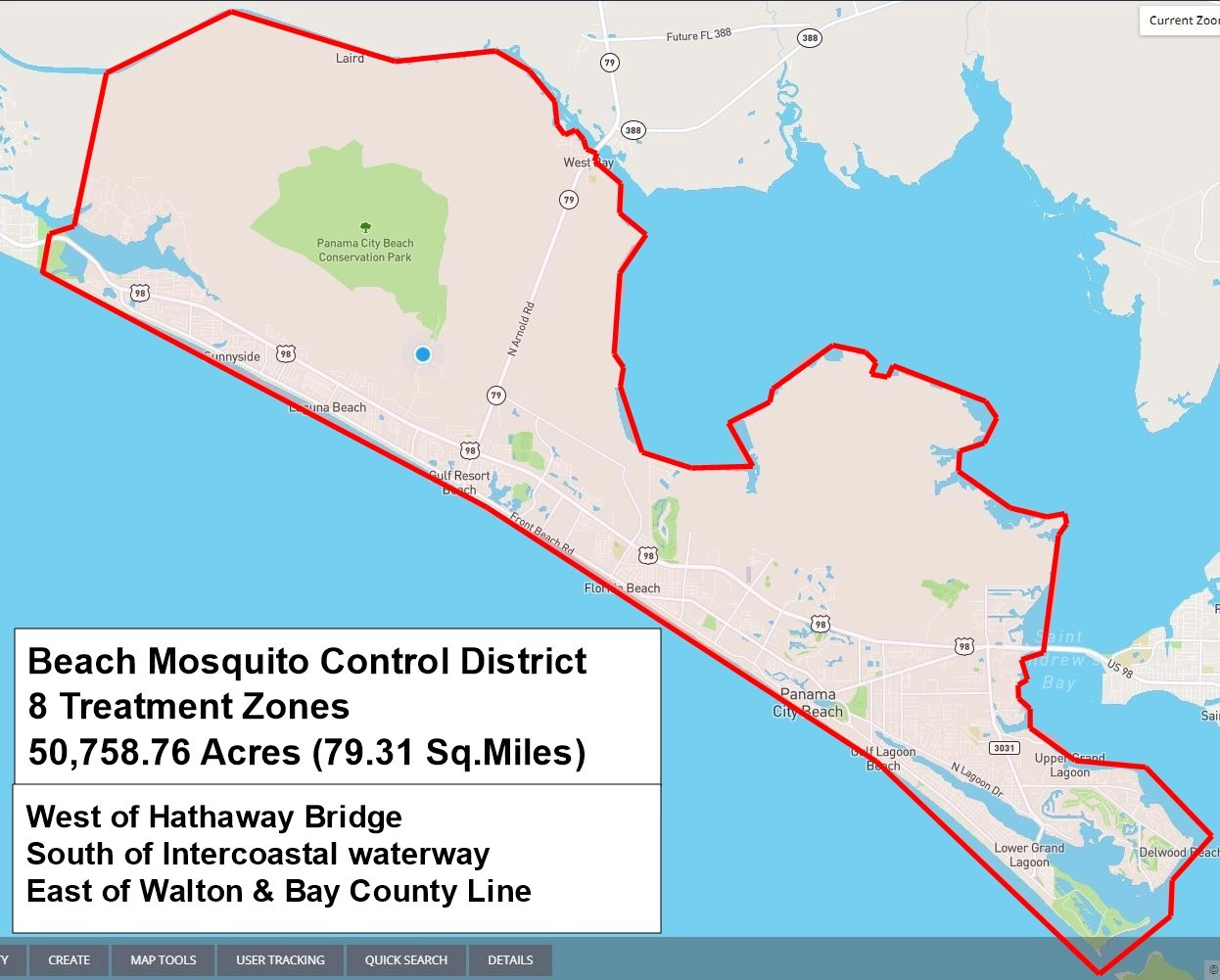
Boundaries
Services Provided
- Larval mosquito control by air and ground
- Adult mosquito control by air and ground
- Arbovirus Monitoring utilizing sentinel chickens & Lab Testing equipment
- Ditch maintenance to assigned district’s ditches and assist with other government entities ditches within the district’s boundaries.
- Public education
- On demand field technician service to citizens of Beach Mosquito Control District
- Assistance to other government entities for the betterment of the district.
- Training center for Florida Panhandle’s mosquito control districts and related industry professionals.
Contact Information
Contact Us:
By Phone: (850) 233-5030
By Email: james@pcbeachmosquito.com
Through Our Website: https://pcbeachmosquito.org
Registered Agent/Registered Office
James Clauson, Director
509 Griffin Blvd.
Panama City Beach, FL 32413
All Taxes, Fees, Assessments, or Charges Imposed and Collected
Ad valorem
Rates or Amounts for the Current Fiscal Year
- Millage rate for fiscal year 2024-2025 is 0.1400
- Millage rate for fiscal year 2023-2024 is 0.1800
- Millage rate for fiscal year 2022-2023 is 0.2200
- Millage rate for fiscal year 2021-2022 is 0.3000
- Millage rate for fiscal year 2020-2021 is 0.3500
- Millage rate for fiscal year 2019-2020 is 0.5240
- Millage rate for fiscal year 2018-2019 is 0.5450
Statutory Authority for the Levy of the Tax, Fee, Assessment, or Charge
Public Purpose Statement
The mission of the Beach Mosquito Control District (BMCD) is to serve the district by suppressing both pestiferous and disease carrying mosquito populations to a tolerable level in the safest, most economical manner, utilizing integrated mosquito management. BMCD focuses on employing public education, surveillance, source reduction, control of larvae & pupae, as well as the control of adult mosquitoes.
Date Established
Originally formed as The Gulf Mosquito Control District on October 14, 1952 when the citizens of the Panama City Beach area voted to create a mosquito control district. The District’s name was changed to The Beach Mosquito Control District in early 1997.
Charter/Creation Document
Establishing Entity (Legislature, County(Ies), Municipality(Ies), or Governor
The Board of County Commissioners of Bay County, Florida
Statute or statutes under which the special district operates, if different from the statute or statutes under which the special district was established:
Ethics
Code of Ethics, if adopted
Generally applicable ethics provisions can be found on the Florida Commission on Ethics website
Fiscal Year Period
October 1 – September 30
Budget Information
- Current BMCD budget information can be found on the
- , including, but not limited to, the following:
- Final Adopted Budget
- Budget Amendments (if applicable)
- BMCD’s Annual Financial Report on the Department of Financial Services website (required by Section 218.32(1)(g), Florida Statutes)